(65 mg each, about 50 mg Iodine)
(2 tablets is an adult daily dose.)
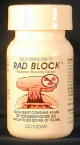
Label dosing recommendations mirrors new WHO guidelines above. (Especially important for dosing children.) Small coated tablets overcome typical KI bitterness when dosing children 3-12 years old with single whole tablet. Bottles are double safety sealed, with childproof cap and contain desiccant for extended storage life. Additionally, we vacuum seal the bottle thereby tripple sealing the tablets from other environmental hazards! How's that for extended shelf life!!!! Product Information Guide (incl. with each bottle& small quantity vac packs)
Certain forms of iodine help your thyroid gland work properly. Most people get the iodine they need from foods like iodized salt or fish. The thyroid can “store” or hold only a certain amount of iodine. In a radiation emergency, radioactive iodine may be released in the air. This material may be breathed or swallowed or ingested with food and drinks. It may enter the thyroid gland and damage it. The damage would probably not show itself for years. Children are most likely to have thyroid damage. If you take Potassium Iodide, it will fill up your thyroid gland and block the uptake of dangerous radioactive iodine. This greatly reduces the chance that harmful radioactive iodine will enter the thyroid gland.
In the aftermath of the Chernobyl nuclear power plant disaster, many children
most likely developed thyroid cancer or thyroid abnormalities because they did
not receive the protection afforded by radiation blocking pills, such as RAD
BLOCK ™, prior to exposure to even small amounts of nuclear fallout. The World
Health Organization said this of the Chernobyl disaster:
"The result, less
than fifteen years after the accident, is more than 1000 cases of thyroid
cancer, most probably solely attributable to this single release of
radioactivity to the environment … In the most affected area in Belarus, the
yearly incidence (of thyroid cancer in children) has risen … more than 100-fold
compared to the situation before the accident. … This increase in incidence has
been documented up to 500 km from the accident site".
If the countries that
surround the Chernobyl nuclear power plant had not given out millions of doses
of KI pills (like RAD BLOCK ™), thousands of more cases of cancer may have
developed. [Note: As of the year 2000, while recommended by the U.S. government
and many research groups, the U.S. still does not widely stockpile KI pills as
in done in many other countries.] Please see our article on Nuclear Power Plant
Hazard Issues for reasons why this is a major problem in the U.S. today.
The US Food and Drug Administration (FDA) recommends taking Potassium Iodide only when public health officials tell you to do so during a radiation emergency (such as a major nuclear power plant disaster or with an explosion either involving nuclear materials or an actual nuclear fission or fusion bomb detonation). In a radiation emergency, radioactive iodine could be released into the air and cause potential health risks for up to hundreds or even thousands of miles (in the case of large nuclear weapons explosions).
Potassium Iodide (KI), a form of Iodine that is quite different than that used to purify water, used to formulate Rad Block tablets, can help protect you by preventing the uptake of radioactive iodine into your thyroid. note: the thyroid, as opposed to the rest of the human body, is extremely vulnerable to even low levels of radioactive iodine.
Directions for Use / Daily Dose:
Use as directed by a physician and as directed by public health authorities.
Adults - 2 tablets taken once per day
Children 3 to 12 years of age - 1
tablet taken once per day
If a child cannot swallow this pill, the pill
should be crushed and administered in milk, juice, jam, soda, etc. – to
eliminate the bitter taste – taken once per day.
Children 1 month to 3 years
of age - One-half (½) tablet crushed and stirred into solution with juice, milk,
jam, or formula . taken once per day
Neonates (birth to 1 month of age) -
Only a single administration of one-quarter (¼) tablet crushed and stirred into
formula, breast-milk, milk, or water should be given to neonates who are in
their first week of life outside of the womb, even for premature babies, unless
otherwise specified by a physician. If approved by a physician, subsequent doses
of one-quarter (¼) tablet crushed and stirred into formula, breast-milk, milk,
or water may be given to neonates after their first week of life if there is a
continuing hazard.
Pregnant and nursing women may take this product (although be sure to refer to the WARNING section that follows) but should consult a physician prior to continuing daily dosages after the second day. Adults and older children should take this tablet preferably with milk or food to limit any potential adverse gastrointestinal response. If only a limited number of RAD BLOCK ™ or similar pills are available, these should be given to infants, children and young adults first as its effectiveness (and also the risk of thyroid cancer) drops off with adults over 40 years of age. Adults 40 and over should not take KI beyond 1 day unless directed to do so by a physician (or unless the adult is continuing to be exposed to high levels of radioactive iodine that threaten thyroid function).
When to take RAD BLOCK™:
Potassium Iodide (KI) should be taken as soon as possible after public health officials tell you and if at all possible, prior to or shortly after radiation exposure. Dangerous radioactive iodine can be blocked by nearly 100% if taken prior to radiation exposure and can still block 50% even hours after exposure. You should take one dose daily (per the preceding paragraph’s guidelines). More will not help you because the thyroid can “hold” only limited amounts of iodine. Larger doses will increase the risk of side effects. You will probably be told by health authorities not to take the drug for more than 10 days after the end of exposure to nuclear radiation (but note the Daily Dosage section above and the Warning section below for pregnant and nursing women and for neonates and for those 40 years of age and older). In the case of a nuclear power incident, this may be less than two weeks total dosage time. In the case of a major nuclear war (even if overseas) or with nuclear materials terrorism incident, authorities may recommend taking KI for 100 or more days for children and young adults.
Warning: At the WHO dosages recommended above, an adverse reaction rate of less than 1 in 10 million children and less than 1 in 1 million adults is expected. However, Potassium Iodide should not be used by people allergic to iodide. According to the WHO, contraindications for use of potassium iodide are: (1) past or present thyroid disease (e.g., active hyperthyroidism), (2) known iodine hypersensitivity, (3) dermatitis herpetiformis, and (4) hypocomplementaemic vasculitis. Pregnant women should consult a physician prior to continuing dosages for more than two days. According to the WHO, “No negative consequences are to be expected after one or two doses of stable iodine. However, especially in areas with dietary iodine deficiency, prolonged dosage could lead to maternal and/ or fetal thyroid blockage, with possible consequences for fetal development. Pregnant women with active hyperthyroidism must not take stable iodine because of the risk of fetal thyroid blockage.” The WHO also states “Side effects in other parts of the body, such as gastrointestinal effects or hypersensitivity reactions, may occur but are generally mild and can be considered of minor importance.” One additional recommendation we urge, now before any nuclear emergencies, is to check with your doctor and inquire whether there is any possibility of any adverse reactions if you, or your children, had to begin taking KI. This is especially important if you are taking regular medications with Spironolactone (like Aldactone), Triamterene (Dyrenium) Amiloride (Midamor), or medicines for an overactive thyroid, or if you are on medications with any lithium-based or potassium-sparing diuretics. You should also check with your doctor before taking this medication if you have myotonia or hyperkalemia congenita or tuberculosis or kidney disease (see www.mayohealth.org/usp/html/202472.htm for more information). It is better to have gotten that assurance from your physician now, before any emergencies, rather than risk hesitating taking it later (or possibly suffering an adverse reaction) because you didn't ask first. Keep out of the reach of children. In case of overdose or allergic reaction, contact a physician or public health authority.
Storage and Shelf-Life:
Store at controlled room temperature between 15° and 30° C (59° to 86° F) and avoid excessive humidity. Keep bottle tightly closed. Potassium Iodide, although required by the FDA to be labeled with a 3-year shelf-life at this time with RAD BLOCK ™, should be effective for decades if stored properly.
Side Effects (See Warning section above):
Usually, side effects of KI happen when people take higher doses for a long time. You should be careful not to take more than the recommended dose or take it for longer than you are told. Side effects are unlikely because of the low dose. Possible side effects include skin rashes, swelling of the salivary glands, and “iodism” (metallic taste, burning mouth and throat, sore teeth and gums, symptoms of a head cold, and sometimes stomach upset and diarrhea). A few people have an allergic reaction with more serious symptoms (see WARNING section above). These could be fever and joint pains, or swelling of parts of the face and body and at times severe shortness of breath requiring immediate medical attention. Taking iodide may rarely cause overactivity of the thyroid gland, underactivity of the thyroid gland, or enlargement of the thyroid gland (goiter). Babies in the womb and breast-feeding babies may develop skin rashes and other thyroid related problems through receiving KI passed through the placenta or from breast milk (see Daily Dosage and Warning section above).
What to do if side effects occur:
If the side effects are severe or if
you have an allergic reaction, stop taking Potassium Iodide. Then, if possible,
call a doctor or public health authority for instructions.
THE OFFICIAL FDA RECOMMENDATION CHART
|
Threshold Thyroid Radioactive Exposures and Recommended Doses of KI for Different Risk Groups | ||||
|
Predicted Thyroid exposure(cGy) |
KI dose (mg) |
# of 130 mg tablets |
# of 65 mg tablets | |
|
Adults over 40 yrs |
>500 |
130 |
1 |
2 |
|
Adults over 18-40 yrs |
>10 | |||
|
Pregnant or lactating women |
> 5 | |||
|
Adolesc. over 12-18 yrs* |
65 |
1/2 |
1 | |
|
Children over 3-12 yrs | ||||
|
over 1 month-3 years |
32 |
1/4 |
1/2 | |
|
birth-1 month |
16 |
1/8 |
1/4 | |
* adolescents approaching adult size (> 70 kg) should receive the full adult dose (130 mg)
| ORDER TRIPLE SEALED 200 TABLET POTASSIUM IODIDE | 1 Bottle $24.99 | 2 Bottles $44.99 | 3 Bottles $59.95 | 6 Bottles $108.00 |
|---|